Custom Patterned Panels: From Concept to Production File
A patterned panel is quick to design but slow to make. We recently began providingproduction files forcustom-madepatterned panelsthrough our Studio reell: in DXF and SVG formats, verified for the machine on which they will be cut.
Where the problem lies with cutting
For years, we’ve been designing everyday items: simple, functional, and printed in Switzerland. Simplicity is intentional, not accidental.
More and more often, people were asking if it could be made bigger. A partition instead of a tray. An acoustic panel instead of a holder. The same design, only on the wall instead of on the table.
Anyone who’s tried this knows exactly where the problem lies. Placing a patterned panel in CAD by hand takes an entire afternoon. Every change to the pitch or web width takes another afternoon. And that’s not all: there’s the inside corner that the milling cutter can’t reach. The web that looks fine on the screen but breaks in the material. The contour that gets distorted during the offset and has to be redrawn by hand by the machine operator.
You can find templates everywhere. What's missing is a file that works without any additional work.
Four Steps to Creating a File
Tell us what you have in mind.A photo, a sketch, or a link to a sample is enough. It usually starts with a vague idea, not a drawing.
We'll send you two or three design options as images, along with the key specifications: number of cutouts, open area, and narrowest web width. This will allow you to see right away whether they're a good fit for your material. The entirefour-step processis outlined on the quote page.
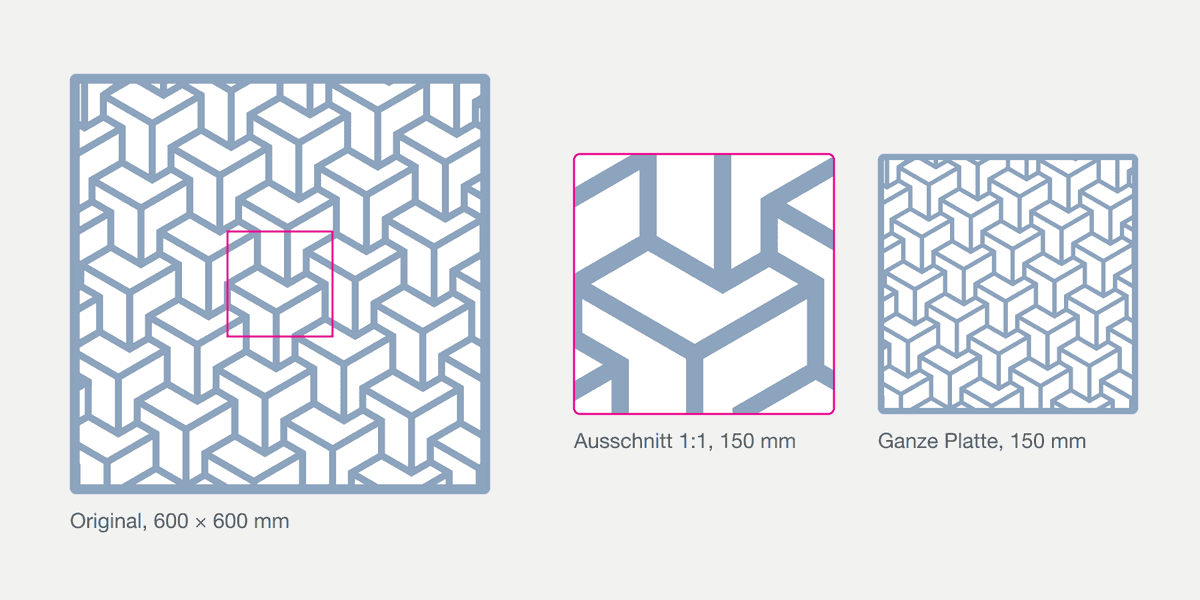
Upon request, we’ll print the selected design as a tilein its original size and send it to you. It’s easy to misjudge the width of the ridges on a screen, but not when you hold it in your hand. This is something we’ve been doing for years—only this time, it’s a sample rather than a finished product.
You will then receive the file, with everything already taken into account: The corner radius matches your tool, since an inside corner becomes rounded anyway during milling. Openings that would be too narrow for your process have been identified and labeled. The DXF file includes separate layers for the outer contour, cutouts, and engraving, with dimensions in millimeters and the origin at the bottom left.
The cutting takes place at your facility. We deliver the file, not the workpiece, which is exactly why we align it with your machine and not ours.
Sizes, Materials, and Price
Formats:DXF R12 with layers, SVG with dimensions in millimeters, PDF for review, and STEP upon request.
Processes:Laser, waterjet, and milling.
Materials:Sheet metal, steel, stainless steel, aluminum, brass. Wood, MDF, multiplex, plywood. Acrylic glass, composite panels, felt, cardboard, plastic. The material primarily determines how narrow a web can be.
Applications:Partitions and room dividers. Doors, gates, and door panels. Trim and cladding. Grilles and railings, in stairwells and on balconies. Facades, privacy screens, and sunshades. Ceilings, suspended ceilings, and acoustic panels. Furniture and cabinet fronts. Light fixtures and lampshades. Trade show booths, storefront displays, and decorative elements.
Acoustic panels are a particularly common topic. Most of the openings are located on a single panel, and that’s where drawing by hand is the most tedious. We provide the file; calculating the absorption is the acoustician’s job.
Price:The design costs CHF 90 and will be credited toward your order. The price for the finished file starts at CHF 280 for a panel featuring a pattern from our collection. You’ll receive the price upfront—no surprises on your invoice.
Examples, formats, andfrequently asked questions about custom panelsare available at reell. To get started on a project, simply send us a quick message via thecontact form—we usually respond within a day.